If you spend time in Western Australia, one thing becomes clear very quickly: people here are used to thinking on a big scale. Big distances. Big industries. Big ambitions.
Why Australia's new mobile coverage map standard needs to reflect real coverage
The Australian Communications and Media Authority (ACMA) is currently consulting on a new standard for the way mobile network providers prepare and publish coverage maps.
Shailin Sehgal · 11 March 2026 · 3 minute read
We think creating a consistent standard for coverage maps is the right move for customers. But what's so important is that the standard leads to maps which are aligned with the actual real world outdoor mobility experience for customers across the country.
In its draft standard, the ACMA sets out a series of categories for coverage with corresponding descriptions that explain the level of coverage a customer should expect to receive at each level (e.g. good, moderate, useable and none).
For each category, there is a signal strength threshold. You can think of these as the level of connectivity your phone needs to be able to perform certain functions like call, text or use data, for each category.
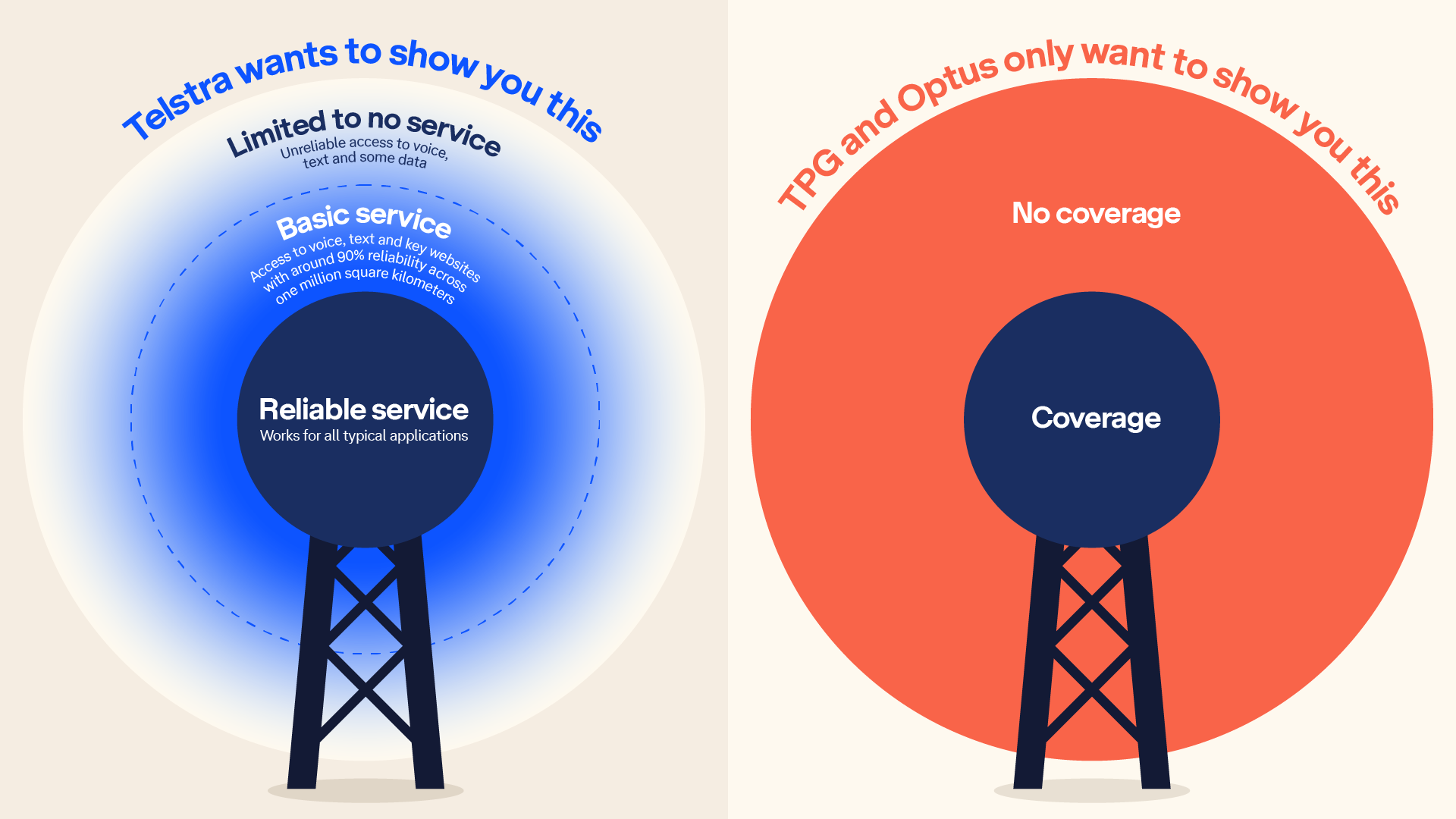
At the moment, the draft standard defines any signal strength below -115 dBm as "no coverage" and this is a real problem for several reasons - including that it would mislead customers and reduce the practical value of coverage maps.
1. Every month more than 1.5 million customers use our coverage below -115 dBm
In fact, customers make around 57,000 emergency calls using this coverage every year. And every day in these coverage areas 700,000 voice calls are made, 750,000 texts are sent and 300TB of data is transferred. That's roughly 100 million photos taken on smartphones.
57,000
emergency calls made every year using coverage below -115 dBm
1.5 million
customers use our coverage below -115 dBm every month
700,000
voice calls made every day in these coverage areas
750,000
texts sent every day in these coverage areas
300TB
of data transferred every day in these coverage areas
2. Multiple third-party audits confirm that our mobile coverage works below -115 dBm
The Government's National Audit of Mobile Coverage recognises that usable coverage exists below -115 dBm. Additionally, in late 2025 we engaged a third-party to spend more than three months driving 60,000km across the country to test how our mobile network stacks up using a regular smartphone (Samsung S25) with no external antenna.
The team tested signal strength, speed, webpage browsing, YouTube performance, tens of thousands of voice test samples, hundreds of thousands of data test samples and measured signal strength for every test.
The results demonstrate that in signal below -116 dBm to the edge of our current coverage map (which would be shown as “no coverage” under the draft standard) customers can typically access the services they require for basic mobility use cases. For example, more than 90% of the time, achieve data speeds that allow customers to load web pages within a few seconds and start applications without excessive delay. And successfully make and maintain intelligible voice calls.
This third-party audit is vastly more extensive than the 20 sites, along one road in Queensland, that TPG claim to have tested in their submission to the ACMA. Their 'audit' is in no way representative of the experience of our customers using our network across the country.
3. It would create a 'void' between where maps show standard mobile coverage ends and satellite to mobile coverage begins
In June 2025 we launched Telstra Satellite Messaging – Australia's first satellite to mobile text messaging service. Currently around 170,000 unique users connect to Telstra’s satellite to mobile service each day. This service kicks in only when your phone can no longer connect to a standard (terrestrial) mobile network, which we know occurs well below -115 dBm signal strength. If this coverage was removed from the comparable maps, it would leave large gaps between terrestrial and satellite coverage in the maps and be enormously confusing for customers.
4. It reduces the incentive to continue investing in regional mobile coverage
In the seven years to 30 June 2025, we've invested $12.4 billion in our mobile network nationally, with $4.7 billion of this invested in regional areas alone. If the draft standard is introduced, the incentive for us to continue investing in regional areas — including at the edge of the network when the comparable map would not represent much of this coverage — is diminished. This would mean customers in regional and remote areas get less and poorer service over time.
How we should represent coverage below -115 dBm on the comparable coverage maps
Customers want to know where they can use their phone for calls, texts and data – and that’s fair enough.
We think -115 dBm should be classified as the lower end of where you can get good mobile coverage outdoors, not a fake cliff edge that doesn’t match what happens on a customer’s phone.
The connectivity customers use below -115dBm should be classified as a “usable” outdoor service, with clear labels so customers know what to expect in this zone.
Some competitors want the standard to leave this coverage out entirely to downplay the large difference between their network and ours. This may work in their favour, but it would mislead customers about our available coverage making it much harder for them to make informed decisions, and it isn't supported by the many third-party audits conducted.
Your questions answered
Do you need an external antenna to use coverage below -115 dBm on your network?
Absolutely not. All our testing, and testing by third parties, has been done with a regular smartphone device with no external antenna.
How does Telstra deliver mobile coverage in areas below -115 dBm?
We've designed, built and optimised our network to give our customers useful coverage in regional areas. It's why our network reaches places where others don't. One example is the use of Cell Extension that increases maximum cell range. We have worked with Ericsson to remove the 100 km range limitation in 4G for areas where coverage can be used past this point. These sorts of innovations and investments enable customers to access coverage in many areas below -115 dBm, that may not otherwise be possible.
Why doesn't my phone always get signal in Telstra's coverage areas?
No map, from any provider, can guarantee mobile service at a particular time or exact location. That's because all our maps are predictions based on extensive modelling and real-world testing. We continue to optimise these to make them as accurate as possible. ACMA's own draft standard recognises predictive modelling as the most appropriate basis for generating comparable maps.
What would excluding coverage below -115 dBm from mobile coverage maps mean for customers?
Since many of our customers rely on coverage below -115 dBm daily and we know it's effective, if the comparable map can't show this, we may need to find an alternative way to demonstrate that this coverage is available.
By Shailin Sehgal
-
-
Temporary Disaster Roaming (TDR) arrives from 1 October. Here's how it works, when we can and can’t turn it on, and how it fits with the backup power, satellites and payphones we lean on when severe weather hits.
-
For those living in some of Australia's most remote locations, a reliable home phone remains an essential link to family, services and support. We're helping customers transition from ageing USO satellite voice services to modern connectivity solutions.