How we’re building a more connected, inclusive and sustainable future
Today we released Telstra’s FY26 sustainability reporting suite, including the 2026 Bigger Picture Report, 2026 Modern Slavery Act Statement and Our Approach to Nature Action report. Together, these documents show the progress we're making to build a more connected, inclusive and sustainable future.
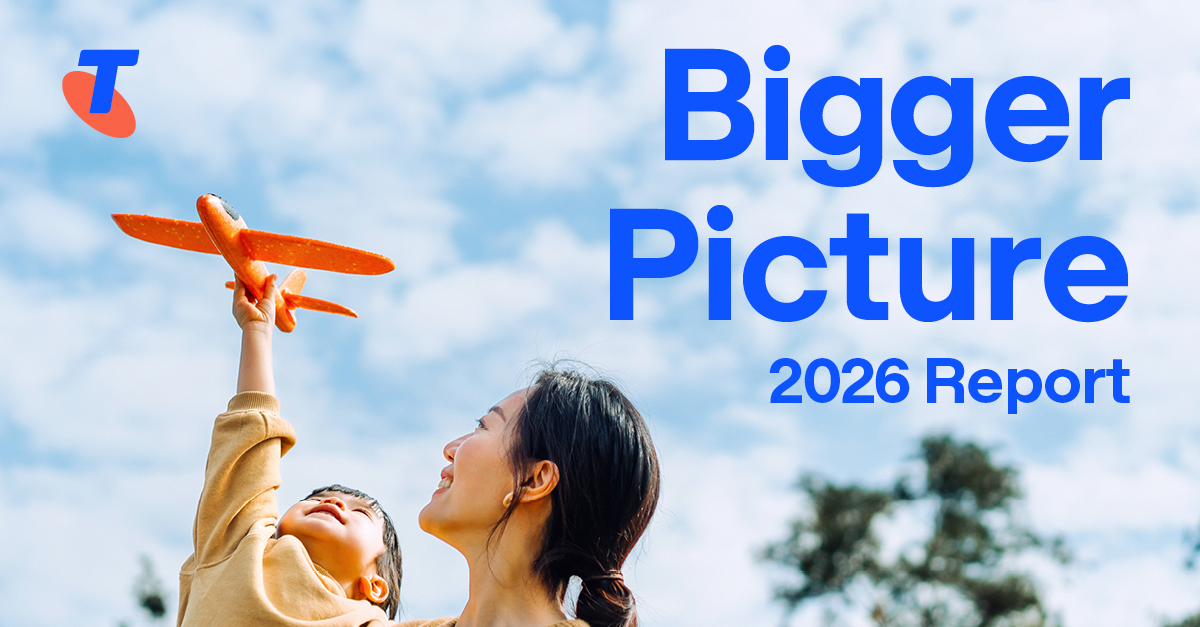
Sustainability is a key enabler of our Connected Future 30 strategy. This year's sustainability reporting suite shows the progress our teams and partners are making to strengthen trust, support more Australians to participate in the digital world, respect human rights and reduce our environmental impact.
What did we achieve in FY26?
In FY26, we supported the digital inclusion of almost 177K people across Australia. This included almost 35K across the Northern Territory, South Australia and Tasmania. We also helped 1.4 million customers in vulnerable circumstances stay connected.
Our environmental progress continued. We reduced our combined scope 1 + 2 emissions by 48% and our scope 3 emissions by 49% from a FY19 baseline, excluding Digicel Pacific. We exceeded our target to enable renewable energy generation equivalent to 100% of our electricity consumption by the end of 2025. As at December 2025, we had enabled generation equivalent to 121% of our consumption.
The sustainability reporting suite also includes our 2026 Modern Slavery Act Statement, which explains how we identify, manage and mitigate modern slavery risks in our operations and supply chains. Our Approach to Nature Action report provides more detail on how we consider nature-related dependencies, impacts, risks and opportunities.
How are we supporting a better digital world?
Digital inclusion means more than access to a device or network. It also means affordability, confidence and the ability to participate safely online.
That is why our work focused on access, affordability and digital ability. We supported affordability by expanding Telstra Top Up, deepened AI skills through AI for Good, and helped more Australians build practical digital confidence through programs including Digital Uplift in Tasmania, Tech Savvy Seniors in NSW and Being Digital in SA.
We also continued to invest in safety, privacy and security online. In FY26, we blocked more than 24 million scam calls and close to 5 million scam SMS messages on average per month.
How are we reducing environmental impact?
Connectivity keeps growing, and so does the need to run our network efficiently. In FY26, we invested $22.2 million in energy reduction initiatives across our Australian operations.
We have reduced electricity consumption in Australia by about 30% from FY19 to FY26. In FY26, we also achieved a 94% network waste recycling rate, and reused, recycled, repaired or donated the equivalent of 32% of smart devices we sold.
These results reflect our long-term efforts to decommission legacy technology, improve energy efficiency and keep materials in use for longer.
How are we building more resilient connectivity?
Australians rely on connectivity for work, study, business, safety and connection. That makes network resilience central to our sustainability approach.
In FY26, backup power assets for network sites withstood about 97% of planned and unplanned power interruptions. We also upgraded more than 1,800 sites with backup power to reduce customer impacts during short-term mains power outages.
What happens next?
FY26 was the first year of our five-year strategy, Connected Future 30. It gave us momentum, and it showed where we need to keep pushing. We will continue to focus on reducing environmental impact, expanding digital inclusion and building trust through clear action and transparent reporting.
Read the 2026 Bigger Picture Report, 2026 Modern Slavery Act Statement and Our Approach to Nature Action report for the full story on our FY26 progress, the challenges we are working through and the actions we are taking.
This is in addition to our first Sustainability Report - Climate Statements under the AASB S2 standard, which were released as part of our Annual Report on 13 August.
You can read more at our Sustainability Hub.
Watch the summary video here