If you spend time in Western Australia, one thing becomes clear very quickly: people here are used to thinking on a big scale. Big distances. Big industries. Big ambitions.
Mobile networks explained: why your mobile signal and coverage change
Mobile networks seem simple from the outside. If there’s a tower nearby, your phone should work. The reality is more complex.
Channa Seneviratne · 28 May 2026 · 4 minute read
Mobile networks are made up of many parts that all need to work together to keep you connected, especially during busy times or major events.
What makes up a mobile network
Behind every call or text, several things must work together:
- Your phone (the actual device).
- The radio signal between your phone and the tower, which can be affected by how far you are from the tower and obstacles like terrain, trees or buildings.
- The mobile tower (base station).
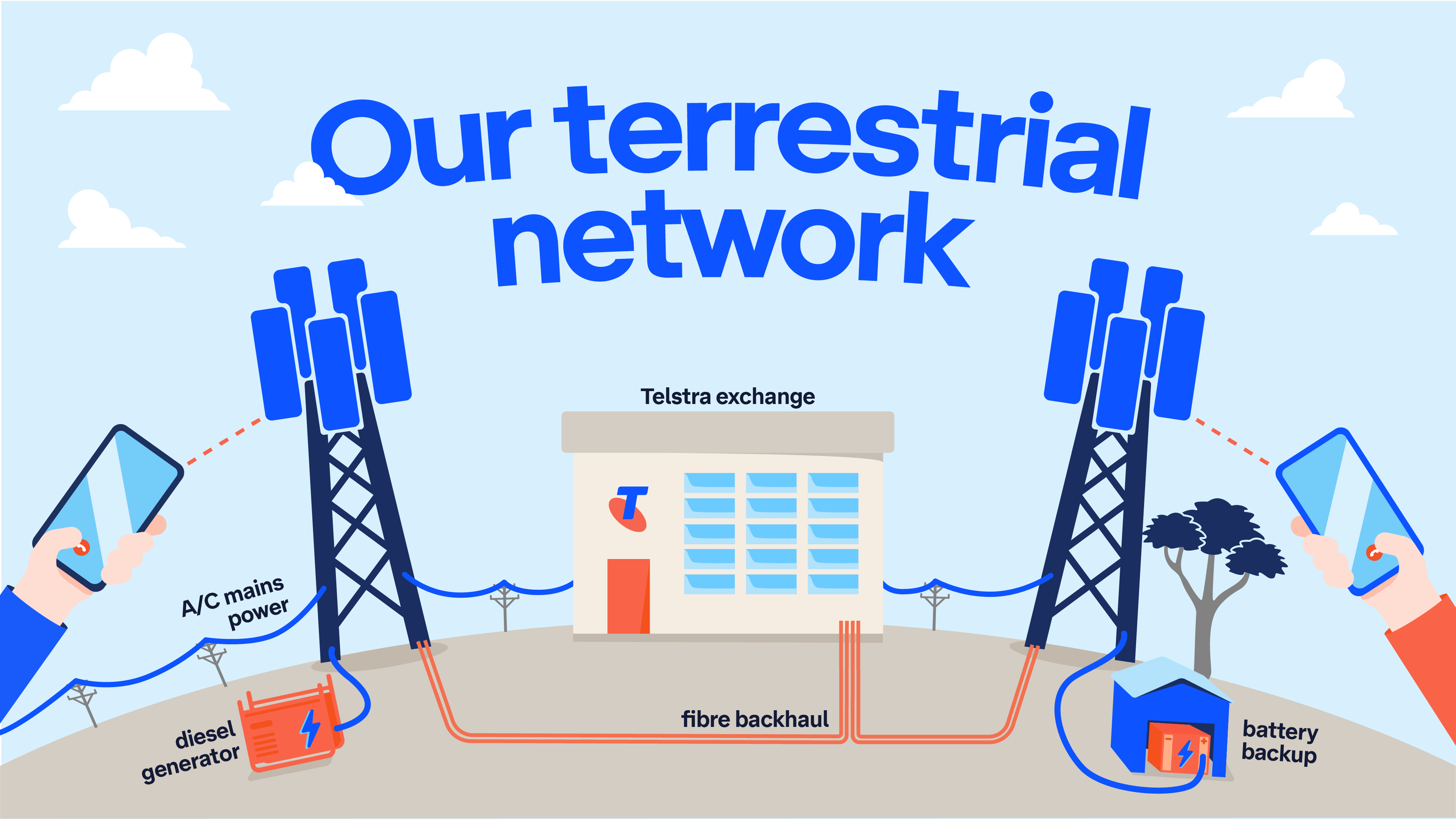
- The connection from the tower back into the network (backhaul).
- The core network that routes the call.
For internet use, there’s one more: the internet itself.
Issues in any one of these areas can affect how easily you can make a call (or how quickly it connects), as well as the quality of your experience and your data speeds.
For example, when it comes to coverage, the strength of the radio signal between your phone and the nearest tower is key. Things like how far away you are, obstacles such as terrain, trees and buildings, or even how you’re holding your phone, can all have an impact.
Signal bars on phones aren’t a reliable measure of signal strength either. They can vary between devices and don’t follow a consistent standard.
What a mobile tower actually does
A mobile tower is really a mobile base station. It’s where your phone connects to the network to make a call, browse the internet or stream video. It’s made up of antennas, radio equipment and software that send, receive and process signals.
Your phone connects to the tower with the strongest signal using radio waves known as spectrum. This spectrum is licenced by government regulation and is tightly controlled and shared across many operators at the same time.
In Australia, spectrum is managed by the Australian Communications and Media Authority (ACMA), on behalf of the Government. They set the rules for how spectrum is divided up (which frequencies, where, and how) to avoid interference between signals and maximise the number of end-users it can support.
You can think of spectrum like lanes on a highway. Each operator’s allocation of spectrum (known as bandwidth) works like adding more “lanes” to help traffic move more smoothly, with network rules to guide how users move between them. If there aren’t enough lanes, or the traffic increases, congestion can build, just like on a busy road at peak hours, meaning services may slow down.
How coverage really works
Coverage isn’t just about having a tower nearby. It’s about two things working together.
Network equipment (transmitters and receivers, known as “transceivers”) + spectrum (the airwaves) = coverage
Transceivers are the physical equipment on towers that both send and receive signals. Spectrum is the invisible layer those signals travel through.
You need both:
- Without spectrum, there’s nothing for the signal to travel on.
- Without transceivers, there’s nothing to send or receive the signal.
Why does coverage vary from place to place?
The main reason is that signal is affected by the natural and physical environment it travels through.
Mobile coverage isn’t simply “on” or “off”. It behaves more like a wave, so your experience can change depending on where you are, what’s around you, and what’s between you and the tower.
Signals weaken with distance and obstacles. Being indoors, behind a hill, inside thick-walled buildings or even in a car can reduce signal strength. Your device also plays a role: its age, design and how you’re using it all matter. That’s why two people in the same place can have very different experiences.
Even if you can see a nearby tower, your connection still depends on how the network is balancing three things in real time: available spectrum, how the equipment is configured, and how many people are using the network.
As conditions change (for example, more customers using that tower), performance usually fades rather than dropping out completely. Data-heavy activities like streaming tend to slow first, while calls and texts often keep working because they need less bandwidth (a narrower lane).
This is also why coverage maps and your real-world experience may differ. Coverage maps are a guide only and show predicted coverage, while your actual experience can vary depending on factors like your location, device, surroundings and live network conditions at that moment.
Why spectrum and tower setup matter
Not all spectrum behaves the same and that directly shapes your experience.
- Lower frequency spectrum travels further and goes through buildings more easily, helping provide broad coverage, especially in regional areas.
- Higher frequency spectrum doesn’t travel as far, but we generally allocate more bandwidth (more lanes) to support busy places like city centres, stadiums and major events.
At the same time, towers and their transceivers (the equipment that both sends and receives signals) aren’t one-size-fits-all. They’re carefully designed to meet the needs of their location:
- A tower in the centre of town is built to support homes, businesses and busy streets, so it typically uses a mix of lower frequencies (for reach and indoor coverage) and higher frequencies with network rules to capture traffic closer to the tower.
- A tower at the edge of town is designed to stretch coverage further, along highways or into less populated areas, so it may rely more on lower frequencies, where demand is lower.
The other half of the story: backhaul
A strong signal from a tower is just one part of the picture. Behind the scenes, that signal also needs to travel back into the wider network. This connection, called backhaul, carries calls and data between the tower and the rest of the network, helping ensure a smooth experience even in busy areas.
There are a few different types of backhaul:
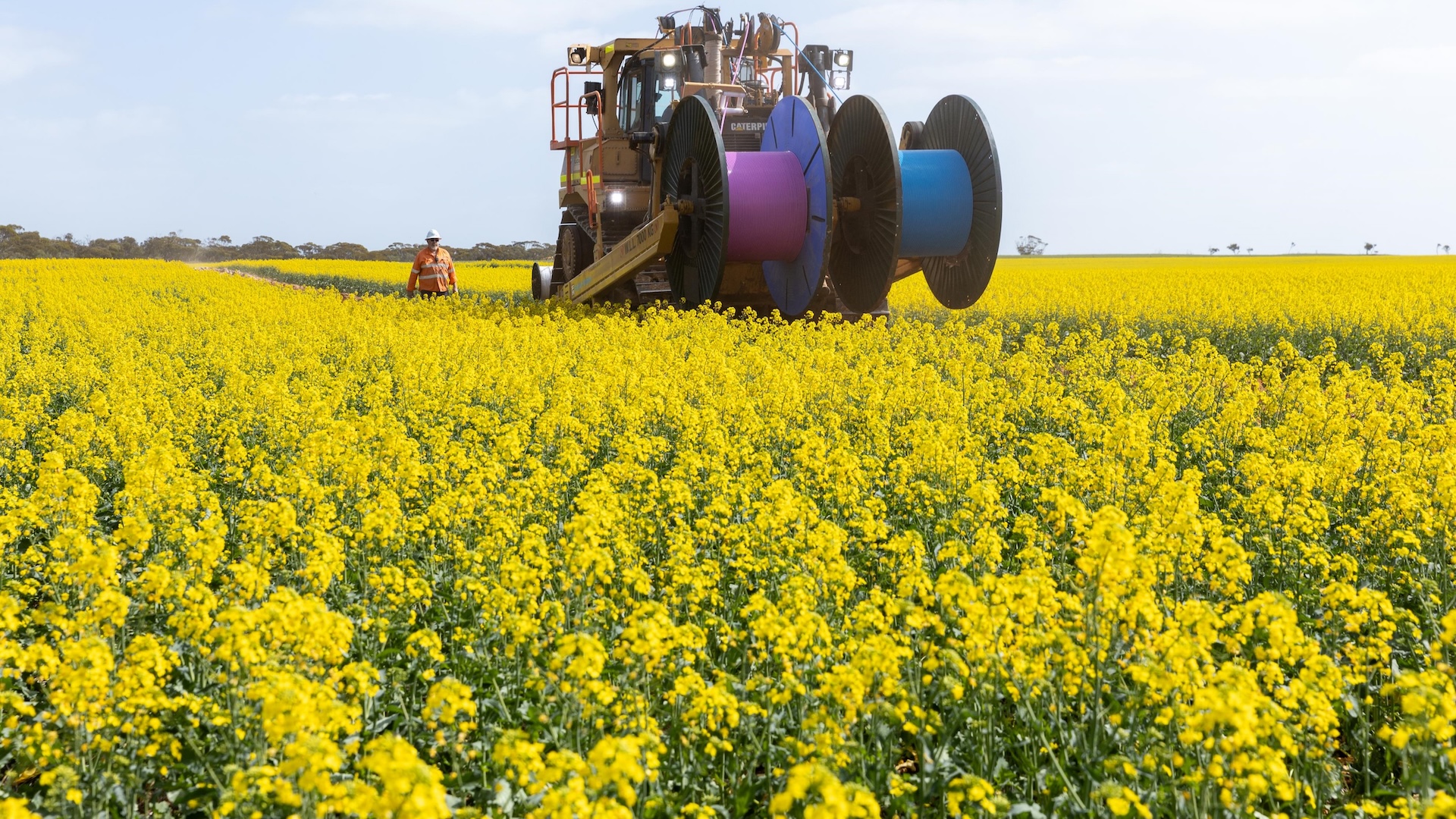
- Fibre backhaul, where a site is connected by optical fibre. This is the ideal as it has the highest capacity, can support more modern technologies, and is typically more reliable and resilient than the alternatives. Fibre cables need to be trenched and laid underground, which can make them harder to deploy in more remote or complex terrain. Like any underground infrastructure, fibre can still be damaged, which is why Dial Before You Dig is so important to help protect these connections.
- Radio (microwave) backhaul, which uses point-to-point radio links from an antenna on the mobile tower pointed toward another antenna on a distant site already connected back into the wider network. These links can have very high capacity and can bridge distances of many tens of kilometres.
- Satellite backhaul, used in very remote areas where neither fibre nor radio links are practical and where traffic demand is low, as the capacity of these satellite links is limited. It can experience short disruptions as the connection moves from satellite to satellite.
- Copper backhaul, an older technology limited in how much data it can carry, which is why it is increasingly being replaced by fibre, radio or satellite options as networks evolve.
How mobile sites are powered, and why reliable energy matters
Mobile towers run on AC mains power from the electricity grid. In more remote locations, or where extra resilience is needed, sites may also use hybrid designs that combine grid power with solar and larger battery systems. These setups help reduce reliance on the grid and can extend how long a site keeps operating during power outages.
There isn’t one single answer to how much power a mobile tower uses. Power demand varies depending on how many technologies are running at a site (such as 4G and 5G), the number of radio transceivers and frequency bands in use, and how much traffic the site is carrying at any given time.
What is consistent is that mobile sites are power-hungry assets. They draw kilowatts of electricity, not watts. A typical site running multiple technologies like 4G and 5G can require around 11.5 kilowatts of power: roughly the same as the daily electricity use of around 10 homes, or about 60 family-sized refrigerators running at the same time.
This level of power demand is why access to reliable mains power is so critical. Backup options are important but can only manage the high energy requirements of mobile sites for short durations.
Backup power: batteries, generators, and how long it lasts
When mains power goes out, mobile sites rely on backup power to stay online. Backup power is about two things: keeping the site running straight away when the grid fails, and how long it can continue operating if the outage lasts.
- Batteries. The first line of backup. When grid power fails, most sites switch to batteries automatically. Most of our sites are equipped with batteries, which typically provide between 3 and 12 hours of backup power. Once batteries are depleted, the site will go offline unless mains power is restored or another power source is available.
- Generators and new technologies. Some mobile sites have generators installed which can run the mobile tower until the fuel runs out. Portable generators can also be installed at sites for outages that last longer, if the site is safe to reach. In Victoria, we’re trialling renewable hydrogen fuel cell backup at five regional mobile sites, with a target of up to 72 hours of backup power.
There’s no single answer to how long it will last, because the energy drain on backup power (from batteries or generators) isn’t fixed but varies with the mobile traffic present. How long a site stays online depends on how busy it is at the time. Events like storms or fires can quickly change demand, sometimes increasing calling and data use as people check in with others, and sometimes reducing it if areas are evacuated.
Duration is also influenced by factors such as battery capacity, whether there’s on-site generation, and practical considerations like space for equipment and safe access during floods or fires.
That’s why resilience programs focus on strengthening backup power at sites where longer endurance can deliver the greatest benefit for local communities, based on an area’s population density and susceptibility to natural disasters, rather than applying a one-size-fits-all approach.
In addition to the installed backup power, we also have field technicians well distributed across regional and metro Australia to install portable generators and refill fuel reserves when it’s safe for them to do so. The ability to access the site is critical to perform these tasks, which is why weather events can prevent access for safety reasons.
Mobile vs fixed broadband: different jobs, complementary strengths
Mobile and fixed broadband are designed for different purposes. Fixed broadband (like nbn) is a large, mostly physical connection into a home or business, capable of carrying very high volumes of users and their data. It’s built to support vast numbers of people doing things like streaming, working from home and running businesses, often with multiple users at the same location doing all of this at the same time.
Mobile networks, by comparison, rely on finite radio spectrum that has to be shared between many people in the same area. That means mobile networks can only carry a fraction of the users and total data that fixed networks handle, but they excel at supporting connectivity on the move.
This is where the two really complement each other. Fixed connections do the heavy lifting for high-demand activities at a single location, while mobile helps keep people connected when they’re away from the fixed network, whether that’s on the road, at work, or out in the community.
Why mobile isn’t always the answer
Mobile technology is powerful, but it has practical limits. The capacity within each antenna is shared, so performance can dip when lots of people are online in the same place at the same time, such as in busy town centres, at major events or during peak commuting hours.
Indoor reliability can also vary depending on the distance from the tower and building materials, which is why mobile operators talk about outdoor coverage rather than indoor.
This is also where Wi-Fi and Wi-Fi Calling can help. When mobile signal is poor indoors, your device can use Wi-Fi for data and, when enabled on a compatible device, Wi-Fi Calling allows calls and texts (including emergency calls) to be made over a fixed internet connection instead of the mobile network.
For people at home or in the workplace, it provides an additional way to connect when indoor mobile coverage is limited.
So while mobile plays a critical role in keeping people connected, it doesn’t replace fixed broadband, it complements it, especially for high-usage homes and businesses. Used together, fixed broadband, mobile networks and features like Wi-Fi Calling help provide more reliable connectivity across different situations.
Satellite to Mobile is here, and it’s going to keep developing
Satellite to Mobile (also known as Direct to Handset) is a new technology that’s already helping Australians connect in more places. Since launching Satellite Messaging in 2025, our customers have sent millions of text messages using satellite when they’ve been outside traditional mobile coverage. In March 2026 alone, almost 200,000 Australians connected to the service each day, showing just how quickly it’s becoming part of how people get in touch beyond the edge of the network.
But it’s important to understand what it can, and can’t, do today.
Right now, early Satellite to Mobile services are primarily designed for sending and receiving text messages. Connections can be intermittent, you need a clear view of the sky, an eligible plan and a supported device, and it’s not the same as having mobile coverage.
Currently, Satellite Messaging is not designed to be an emergency service, especially as you cannot text Triple Zero directly. So if you’re planning on visiting remote regions, it’s always recommended to plan ahead and take extra precautions in case of an emergency.
What’s important is where this is heading.
As the technology evolves, Satellite to Mobile will play an increasingly important role in connecting regional and remote Australia, supporting not just messaging, but over time enabling voice calls and basic data services.
It’s not about replacing mobile networks. It’s about complementing them.
Looking ahead, Australia’s connectivity will be powered by three technologies working together:
- Fixed networks for high-capacity, always-on connectivity.
- Mobile networks for everyday coverage and mobility.
- Satellite to extend reach into the hardest-to-connect areas.
Together, they’ll help ensure Australians can connect in more places, more often, whether they’re in the city, the regions, or beyond the edge of the network.
-
-
Temporary Disaster Roaming (TDR) arrives from 1 October. Here's how it works, when we can and can’t turn it on, and how it fits with the backup power, satellites and payphones we lean on when severe weather hits.
-
For those living in some of Australia's most remote locations, a reliable home phone remains an essential link to family, services and support. We're helping customers transition from ageing USO satellite voice services to modern connectivity solutions.