➤ 2026
24 Feb
5G: World's fastest 5G standalone uplink (again)
Telstra, together with our partners Ericsson and Qualcomm recorded the world’s fastest 5G Standalone uplink speed on a live commercial network. Using our mid‑band 5G spectrum assets, including aggregated spectrum in the 2.6 GHz and 3.6 GHz bands, the breakthrough reached peak uplink speeds of 682 Mbps thanks to ongoing 5G Advanced optimisation - strengthening upload performance for real‑time, data‑intensive experiences such as live streams and supporting the next generation of AI-first mobile apps.
➤ 2025
24 Jul
5G: Automated Carrier Aggregation in a live commercial network
Automated Carrier Aggregation has been trialed across more than 50 live 5G Advanced sites in North Sydney. It enables the intelligent and automated selection of the best carrier combinations in real time, adapting to dynamic network conditions to provide our customers with even more consistent, reliable, and faster connections. For Telstra, this innovation means simpler, more autonomous network operations and significant operational savings.
30 May
5G: Successful world-first install of 5G FDD Massive MIMO radio
Telstra is the first telco in the world to install Ericsson's AIR 3284 5G triple-band FDD Massive MIMO radio into its network that will deliver better streaming, faster uploads, and more reliable connectivity during peak times to Telstra customers as part of Telstra's four-year network transformation.
4 February
5G: New benchmark for 5G uplink speeds
In collaboration with Ericsson and Qualcomm, achieved a world-first by setting a new record for 5G uplink speeds at 516 Mbps. This milestone supports the growing importance of 5G uplink capabilities as customer applications require increasingly higher upload speeds for live streaming, video conferencing, and real-time data processing with AI. It's another way we're continuing to innovate and improve customer experience as we push the boundaries of uplink optimisation, capacity, and resiliency.
24 January
5G: New benchmark for commercial 5G speeds
Teaming up with Ericsson and MediaTek, we hit a new milestone by reaching a downlink speed of 9.4 Gbps on our live 5G Standalone (SA) network. In the lab we drove the needle even higher, surpassing the 10 Gbps mark in testing on a non-commercial setup.
These achievements are important as they lead to improvements in our network and customer devices, pushing the mobile ecosystem for more seamless and resilient connectivity. The headline is speed, but speed is directly proportional to capacity, and consequently, the consistency of customer experience.
This means that in places where we have the right spectrum, customers with compatible devices will enjoy a smoother and more consistent experience whether they are streaming, gaming, working remotely or in busy areas and busy times like under the Sydney Harbour Bridge on New Years Eve or during a centre court final at the Australian Open. It's also a big win for emerging applications that need high throughput, such as AI, AR, and VR.
This record-breaking achievement was made possible through our collaboration with Ericsson and MediaTek, integrating the Ericsson Radio System base station with the latest 5G Advanced software and MediaTek's Mobile Test Platform at Telstra's Innovation Centre on the Gold Coast.
➤ 2024
25 October
5G: rApp deployed in a live commercial network (EACC - Ericsson Automated Configuration Consistency)
Telstra partnered with Ericsson to successfully trial the AI-powered EACC rApp on our live commercial network, using the Ericsson Intelligent Automation Platform (EIAP). This breakthrough application brings real-time, automated configuration consistency to our Radio Access Network, allowing us to detect and correct issues efficiently, without impacting service quality. By leveraging AI for self-optimization and self-correction, the EACC rApp streamlines our network operations, reduces complexity, and ensures our customers enjoy even more reliable, high-performance connectivity.
21 October
5G: World record for fastest 5G uplink
Alongside our network partners, Ericsson, we set a new global record for 5G uplink speed, achieving 447 Mbps on our live commercial 5G Standalone (SA) network. This milestone, achieved at Telstra's Southport Innovation Centre, surpasses the previous record by over 100 Mbps and sets a new benchmark for uplink performance in a 5G SA network.
Fast uplink speeds are going to become an in-demand commodity as applications related to AR/VR in consumer and enterprise start to scale. This is why we are proactively working hard to boost uplink and optimize uplink performance. The 447 Mbps uplink speed is particularly significant for applications requiring high data upload capacity, such as high definition live streaming, video conferencing, and other upload data-heavy applications, particularly in entertainment, industrial and enterprise environments.
This achievement represents a significant leap forward in what is possible with 5G, especially in meeting the increasing demands for faster, more reliable data connections for a wide range of services and industries.
14 August
5G: World first deployment of 4th generation Radio Access Network (RAN) compute platform on a live network
This deployment marks the world's first use of these advanced baseband units, or "servers," in a commercial network. Baseband refers to the brains of the radio network that underpins all the processing related to all customer experience attributes.
These new servers are crucial for enhancing the capabilities of our 5G network to bring a superior customer experience and open the gateway to 5G Advanced and 6G technology. From a technical perspective, these baseband units handle essential digital signal processing tasks, such as modulation and encoding, which are vital for managing data traffic.
They help to improve the coverage, speed, and overall experience for our customers when downloading, using apps, and streaming content on their mobile devices. Additionally, these servers are future-ready to drive 5G Advanced features including differentiated service experiences such as network slicing.
These servers are also more energy-efficient, reducing power consumption and heat generation helping to reduce our emissions. The deployment of six of these Ericsson baseband units at a Telstra aggregation site in Melbourne is expected to reduce power usage by up to 60%.
Along with power efficiencies the new capabilities of these servers will increase our capacity in the network to meet our customers' growing mobile data needs.
22 July
5G: World first traffic on enterprise router steering multiple network slices
This is a big milestone in reaching the potential of network slicing within our 5G network. These trials in our lab centred on a feature called UE Route Selection Policy (URSP) in combination with an enterprise router. URSP steers specific application traffic to specific network slices, which can then be tailored to guarantee the application experience, for example ensuring high quality video calls. By successfully enabling URSP in Ericsson's 5G Core, in combination with an enterprise router, it brings us another step closer to delivering customers personally optimised connectivity services to support their increasingly varied connectivity requirements.
20 June
5G: The longest ever first voice call (VoNR) using 5G standalone on a commercial network
We don't think a lot about voice calls these days, especially in the city where most interactions are delivered over mobile data. But in rural and regional areas especially, voice is vital.
With this world record - we made a voice call over our 5G Standalone network at a distance of 99.8 kilometres from the tower that was powering it in Burra, South Australia.
This more than doubles what was capable previously and was made possible using the latest software, spectrum and technology innovation from our partners Ericsson and Qualcomm.
Currently, the 5G standalone tech used to make this call is supported by the Samsung Galaxy S23 and Galaxy S24 range of devices. But more supported devices are expected in the near future.
This builds on our 5G standalone announcement from February where we announced we'll be bringing a world leading 5G slicing product to market this year, made possible by a newly developed proof-of-value engine.
26 February
5G: 5G slicing proof-of-value engine. Deliver committed performance levels for enterprise customers
Telstra has developed a new proof-of-value engine for 5G slicing, designed to deliver and guarantee committed performance levels for our enterprise customers. This breakthrough enables us to create multiple virtual networks, each with tailored performance characteristics, on the same physical 5G infrastructure. Our engine analyses 5G slicing traffic every second, ensuring customers receive the performance they've been promised, with transparent reporting and billing only when those commitments are met. This means we can confidently offer minimum speeds, uptime, and custom network slices for a wide range of use cases, from construction sites and transport networks to public safety and critical business operations.
9 February
5G: 5G core efficiency - AMD high density processors 49% less power consumption
In partnership with Ericsson and AMD, we've achieved a major leap in 5G core efficiency by deploying AMD's latest high-density Genoa processors within Ericsson's Cloud Native Infrastructure Solution (CNIS) on our private cloud. This world-first deployment, powered by Hewlett Packard Enterprise's closed-loop liquid cooling, has delivered up to 49% less energy consumption for our 5G Core functions compared to traditional solutions.
19 Feb
Transmission: King Island 116 km microwave link (9.8 Gbps - 99.99% availability).
A world first and tenfold capacity boost to a remote community off Tasmania, King Island, with the launch of Australia's longest over-water microwave telecommunications link with a throughput capacity of 9Gbps at 99.99% availability.
13 Feb
5G: World first 340 Mbps uplink speed over 5G Standalone using sub 6 GHz frequencies in a live commercial network.
This world first achievement enables Telstra customers to enjoy faster and more reliable data uploads on their 5G Standalone (SA) devices, enhancing their experience of sharing videos, photos and live streams. The new 5G Standalone uplink capability combines Telstra's mid-band spectrum holdings to create a massive 140MHz channel for sending data from the device to the network. This is complemented by a 240MHz channel for receiving data from the 5G SA network to the device, delivering up to 3.6 Gbps in downlink speed and an uplink speed of 340 Mbps – the fastest in the world using spectrum under 6GHz.
➤2023
December
5G: As 5G becomes a more mature technology and the priority of our network development and expansion, being able to not only access the internet over 5G, but also make calls on 5G is equally important. Without VoNR or 5G Stand Alone, even if there is 5G coverage in the area someone was calling from, the call will actually take place over our 4G network. Beginning with a handful of devices including the Google Pixel 7 and Pixel 8 series and Samsung Galaxy S24 series, calls in regional areas that don't support 5G Standalone will now be able to be made over our 5G network with this technology, meaning a more seamless and reliable experience for callers.
28 Feb
5G: World first completion of long distance 5G data call over mid-band spectrum.
This world-first achievement was conducted at Burra in South Australia and made possible through a new software feature that extends the maximum cell range from 15km out to 100km. The extended range feature enables us to broaden the benefits of 5G even more for rural and regional areas, delivering 5G capacity and downlink speeds to more customers.
Although situations allowing a full 100km extension will be limited due to the lack of line of sight in some areas, there are many areas in regional/rural Australia where effective 5G coverage will now reach well beyond 15km, meaning more 5G coverage in more places.
➤2022
November
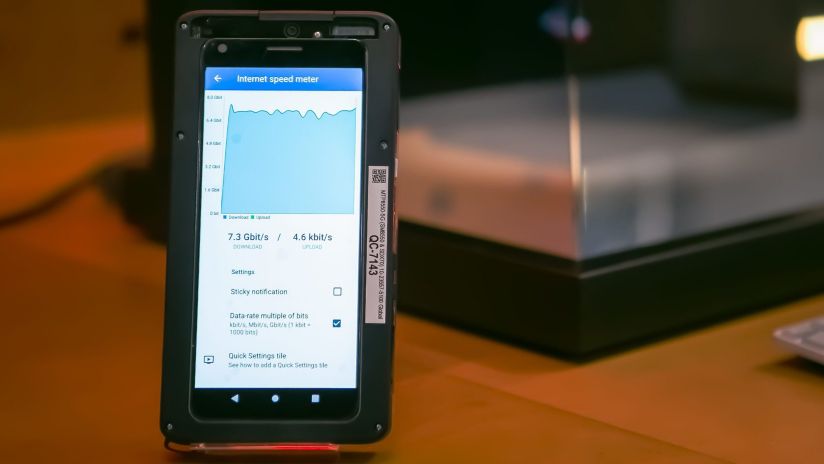
5G: Fastest downlink speed (7.3Gbps) in a commercial network (5G Standalone)
31 Aug
5G: World first deployment with Ericsson of fully automated 5G network slicing on a commercial network – August, 2022
5G network slicing allows us to carve up our world-leading mobile network into separate, secure slices that can be finely tuned to suit the needs of many customers and customer applications. These slices can be tailored to provide an assured network experience with attributes such as minimum committed up and down speeds, lower latency for faster responsiveness of applications, critical application prioritisation or even network resource separation for greater security and reliability. Using this new set of capabilities allows Telstra to create solutions to meet the needs of our business partners and industries, leveraging wireless networks as a primary connectivity solution.
28 Feb
5G: Fastest downlink speed (5.9 Gbps) in a commercial network (5G Standalone)
Telstra set a new benchmark for 5G performance, achieving a record-breaking 5.9 Gbps downlink speed on commercial 5G Standalone network, a nearly 1 Gbps leap over our previous record in just one year. This milestone was made possible through close collaboration with our technology partners and the use of the next-generation Qualcomm x65 platform, combined with 8 contiguous 100 MHz carriers of mmWave and mid-band 3.6 GHz 5G, leveraging "New Radio Dual Connectivity."
|